
Iron Brick AI Field Guide · Strategy ·
Not every problem needs an agent. Understanding the three approaches helps agencies match ambition to risk and to the data they can trust.
Traditional AI: retrieves and responds
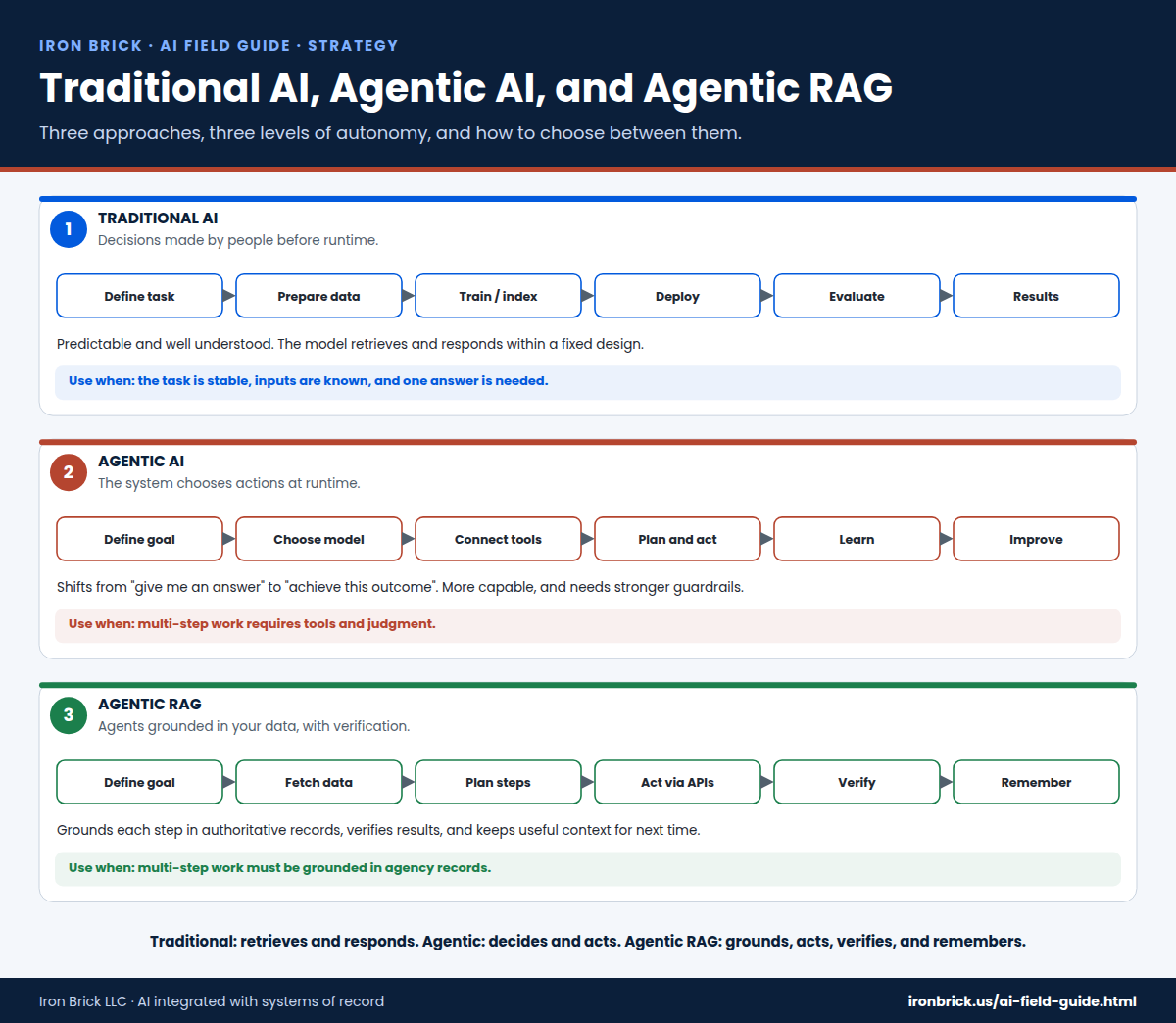
Data is prepared, a model is trained or an index is built, and the system answers within a fixed design. People make the important decisions before it runs. It is the right choice for stable, well-defined tasks.
Agentic AI: decides and acts
An agent is given a goal and tools, and chooses its own steps at runtime. That flexibility is powerful for multi-step work, and it is exactly why agents need narrow tools, loop limits, logging, and human approval for consequential actions.
Agentic RAG: grounds, acts, verifies, and remembers
Agentic RAG adds two things agencies need: every step is grounded in authoritative data retrieved through governed APIs, and results are verified before they are used. The verify step is the whole difference between a useful assistant and an unaccountable one.
How to choose
Stable task with known inputs: traditional. Multi-step work needing tools and judgment: agentic. Multi-step work that must rest on your own records: agentic RAG, with verification and audit built in.
Key takeaways
- Use the least autonomous approach that meets the mission need.
- Agentic systems need narrow tools, limits, logging, and human approval.
- Agentic RAG adds grounding in authoritative records and a verification step.
- Retrieve and act only through governed, audited APIs.